

Authorization Criteria for 28-Inch 3-Band Traffic Cones List
General
The procedure below establishes the protocol for the technical evaluation of 28-Inch 3-Band Traffic Cones used by the Maintenance Division crews to ensure safety, durability, and operational reliability. It outlines the specific criteria for authorization, verifying that the products meet or exceed established standards and requirements.
28-Inch 3-Band Traffic Cones must be officially listed on the Authorized Materials List (AML) before they are eligible for competitive bidding or purchase for use by the Division of Maintenance. Before a product is listed on the QPL, it must undergo a technical evaluation against the established Authorization Criteria for that specific product.
Supplemental Resources
Caltrans Construction Contract Standards: https://dot.ca.gov/programs/design/ccs-standard-plans-and-standard-specifications
New Products Submittal Requirements
Submit the completed submittal package to the Product Evaluation Program (PEP) at New.Products@dot.ca.gov. For new materials, the manufacturer must provide:
- Completed and signed Authorized Material List Submittal Form, DOT TL-9502. To download this form and for more information, please visit the Caltrans Product Evaluation Program website.
- Product technical data sheet.
- Test results from an independent third-party testing laboratory verifying compliance with the Authorization Criteria.
- When requested, samples of the traffic cones must be submitted to the Chemical Testing Branch (see Section 2 of the Authorization Criteria).
Reauthorization Submittal Requirements
Submit the completed submittal package to the Product Evaluation Program (PEP) at New.Products@dot.ca.gov. For reauthorization the manufacturer must provide:
- Formal statement indicating whether any changes have been made to the product.
- Completed and signed Authorized Material List Submittal Form, DOT TL-9502. To download this form and for more information, please visit the Caltrans Product Evaluation Program website.
- Product technical data sheet.
- Test results from an independent third-party testing laboratory verifying compliance with the Authorization Criteria.
- When requested, samples of the traffic cones must be submitted to the Chemical Testing Branch (see Section 2 of the Authorization Criteria).
Authorization Criteria
1. Requirements
The 28-inch 3-band traffic cones shall meet the requirements listed below:
1.1. General
1.1.1. The 28-inch traffic cones shall meet the Manual for Assessing Safety Hardware (MASH) Criteria for Category 1 devices.
1.1.2. Unless otherwise indicated, all tests shall be performed on samples conditioned for a minimum of 40 hours at 25 ± 2 °C (77 ± 3.6 °F) and 50 ± 5% relative humidity.
1.2. Materials
1.2.1. Cone section shall be composed of 100% recyclable fluorescent orange polyvinyl chloride (PVC) compound.
1.2.2. Cone base shall be composed of 100% post industrial recycled black polyvinyl chloride (PVC) compound, injection molded.
1.2.3. Cone section shall be retroreflectorized by a 6-inch-wide white band located 3 to 4 inches from the top of the cone, an additional 4-inch-wide white band located approximately 2 inches below the 6-inch band, and an additional, third, 4-inch orange band located approximately 2 inches below the 4-inch-wide white band.
1.2.4. Cone base shall be retroreflectorized by white dots as shown in Figure 1.
1.2.5. The retroreflectorized bands shall be visible at a minimum of 1,000 feet at night under illumination of legal high beam headlights, by persons with vision of or corrected to 20/20.
1.2.6. All retroreflective bands and dots shall consist of ASTM D4956 Type VI elastomeric sheeting. The sheeting shall meet the required minimum Coefficient of Retroreflection (RA) values for ASTM D4956 Type VI sheeting at 0.20° observation and -4° entrance angles.
1.2.7. The sheeting shall utilize a manufacturer-certified pressure-sensitive adhesive system for permanent bonding to both virgin and recycled PVC surfaces, and it shall be resistant to plasticizer migration. All retroreflective bands and dots shall be fully adhered to the cone and shall be recessed to protect the sheeting from wear.
1.3. Measurements
Table 1. 28-inch cone measurements
| Measurements | Requirements | |
|---|---|---|
| Total weight | 10.0 – 10.5 lb | |
| Base weight | 6.5 – 7.0 lb | |
| Total height | 28.0 ± 0.5 in | |
| Base length | 14.25 ± 0.25 in | |
| Base Width | 14.25 ± 0.25 in | |
| Conical section wall thickness | Top | ≥ 0.14 in |
| Bottom | ≥ 0.16 in | |
| Hole sizes (Centered on base) | Top | 1.25 – 1.5 in |
| Bottom | 10 ± 0.25 in | |
| Long cleats size | 2.5 in x 1.25 in | |
| Round cleats size | 1 in x 0.75 in | |
| Cleats height | 0.5 – 0.625 in | |
See Figure 1 for additional dimensions. Specifications provided in Section 1.3. supersede the dimensions and notes in Figure 1.
1.4. Color
1.4.1. The outer layer of the conical section shall be a bright fluorescent red orange when tested in accordance with ASTM E991. ASTM E991 coordinates are provided in Table 2.
Table 2. ASTM E991 coordinates for Color Measurement of Fluorescent Specimens
| X-Coordinate | Y-Coordinate |
|---|---|
| 0.590 | 0.410 |
| 0.560 | 0.380 |
| 0.610 | 0.390 |
| 0.690 | 0.310 |
1.5. Tensile strength
1.5.1. The conical section of the cone shall be tested in accordance with ASTM D638. The test specimens shall be Type IV. The speed of testing shall be 20.0 inches/minute. The required properties are provided in Table 3.
Table 3. Tensile strength properties requirements
| Properties | Requirements |
|---|---|
| Tensile strength | ≥ 1200 psi |
| Elongation | ≥ 200% |
| Tensile strength at 200% elongation | ≥ 1000 psi |
1.6. Tensile strength of the joint
1.6.1. The tensile strength of the joint where the conical portion of the cone joins the base shall be a minimum 13.8 lbs/inch. Three reduced section test specimens shall be cut from each cone to be tested. The reduced section shall be a neatly trimmed 2.0-inch width at the joint between the cone and base sections. Length of the test specimen will vary depending on the size of the cone being tested, but in all cases, the length shall be sufficient to permit clamping ends of the specimen in standard textile jaws or other suitable grips of a tensile test machine. The test machine shall be capable of maintaining the specified jaw separation rate of 6.0 inches/minute. Divide the total load required to separate the specimen by its width. Report the average of the 3 tests.
1.7. Hardness
1.7.1. The conical section of the cones shall have a Shore A hardness value of 80 ± 10. The hardness shall be determined in accordance with ASTM D2240. The durometer shall be Type A, with a total weight of 4.4 pounds (2 kg) centered on the axis of the indenter. The scale shall be read 15 seconds after the pressure foot is in firm contact with the test specimen.
1.8. Base
1.8.1. Cone base shall be securely and permanently bonded to the wide end of the conical section.
1.8.2. Cone base shall have cleats with minimum dimensions described in Table 1 of this specification and as shown in Figure 1.
1.8.3. Cone base shall have recesses filled with reflective material and meet the minimum dimensions shown in Figure 1.
- The recesses may be milled or otherwise manufactured.
1.9. Stacking
1.9.1. The cone design shall allow for natural separation under gravity alone. No excessive friction, binding, or deformation may impede self-separation. The cones shall be compatible with the currently stocked cones (list available upon request to DOT).
1.9.2. Cone shall stack as shown in Figure 2.
1.10. Labeling
1.10.1. "CALTRANS" shall be printed horizontally on the conical section of each cone using 0.75-inch black lettering centered between the bottom edge of the lowest reflective band and the base of the cone.
1.10.2. The method of application shall produce neat, colinear, permanent lettering that cannot be removed without damaging the cone.
1.11. Workmanship
1.11.1. Defects
Traffic cones shall be free from the following:
- Burns
- Discoloration
- Streaks
- Runs
- Air bubbles
- Bumps
- Ridges
- Voids
- Objectional marks or defects which affect appearance and serviceability
- Defects to the connection between the base and cone that may lead to delamination
- Wrinkles in the reflective material
- Discoloration in the reflective material
- Lifting of the reflective material
1.12. Performance Requirements
1.12.1. Fold Test
- Place the traffic cone in a normal standing upright position on a flat and level surface and fold at a point near the approximate middle of the cone’s vertical height.
- Hold the upper tip of the traffic cone for 10 seconds in a position adjacent to the base while touching the flat surface where the traffic cone is resting.
- When released, the traffic cone shall return to its original vertical upright position within fifteen 15 seconds.
1.12.2. Heat Resistance
- Suspend a 3-pound weight inside the conical section of the traffic cone utilizing a wire attached to the center of a flat metal disc spanning and resting upon the top opening of the traffic cone.
- Place the weighted traffic cone in a normal standing upright position in a pre-heated, 80 °C (176 °F), air-circulating oven for 1 hour.
- The traffic cone shall not exhibit any slumping, sagging, or discoloration. The height of the cone shall be still within the range of 28.0 ± 0.5 in.
1.12.3. Storage and Stackability Test
- Prepare two stacks of 10 traffic cones. One stack is composed entirely of new cones, and the other stack is composed of 5 new cones and 5 currently stocked cones (list available upon request to DOT), stacked alternately.
- Place the traffic cone stacks in a normal standing upright position in an air-circulating oven. Expose the traffic cone stacks to 168 hours of cyclic testing composed of 7 periods of 14 hours at 80 °C (176 °F) and 7 periods of 10 hours at ambient temperature (at or below 25 °C (77 °F)).
- After the thermal cycle, the traffic cones shall separate easily without additional effort. The height of the cone shall still be within the range of 28.0 ± 0.5 in.
1.12.4. Cold Resistance
- Traffic cones shall be preconditioned for a minimum of 2 hours at -18 °C (0 °F) in an environmentally controlled test chamber.
- A steel ball weighing 2 pounds shall be dropped at a distance of 5 feet through a virtually frictionless vertical guide to impact the surface of the cone.
- The surface of the traffic cone being struck by the steel ball shall be in a horizontal position supported by 1 edge of the cone’s base and held in position by a support at the narrow or top end of the traffic cone.
- The traffic cones shall be subjected to 3 impact tests spaced a minimum of 6 inches apart.
- The traffic cones shall not exhibit fracturing, cracking, and/or splitting of the conical section and/or base of the traffic cones.
1.12.5. Color Fastness
- The exterior side of a coupon cut from the traffic cone shall be exposed for 500 hours in accordance with ASTM G155, Table X3.1, Cycle 1 in a Xenon Arc Light Apparatus.
- After exposure, the test specimen shall meet the color requirements in Section 1.4.1 of this specification.
1.12.6. Base Bend Test
- Remove the base of the traffic cone by cutting the conical section at its junction with the top surface of the base.
- Bend the base 180 degrees around a rigidly mounted round mandrel with the upper surface of the base adjacent to the mandrel and securely clamp the base in that position.
- The diameter of the mandrel shall be 2 inches.
- 2 minutes after clamping the base into a 180-degree bend position, examine the base for failure/rejection represented by splitting and/or tearing of the traffic cone material.
- If no failure/rejection occurs, use a knife to cut a 1/32-inch-deep section on the outside radius of the bend and parallel with the longitudinal axis of the mandrel.
- Wait 2 minutes after making the knife cut and examine for tearing.
- Failure/rejection is categorized as tearing of the base material more than 1/8 inch beyond the depth of the cut.
2. Inspection and Sampling
2.1. General
2.1.1. Traffic cones shall be sampled and sent to the Department of Transportation, Chemical Testing Branch for testing.
Sample delivery address:
Attn: FNU Novendra
California Department of Transportation Laboratory
Chemical Testing Branch
5900 Folsom Boulevard
Sacramento, CA 95819
2.1.2. An official sample of traffic cones shall consist of 20 randomly selected cones representing lot quantities up to 4,000 units. For lots larger than 4,000 units, 5 additional cones shall be sampled for every 1,000 cones or fraction thereof.
2.1.3. Time required for testing shall not exceed 60 calendar days.
2.1.4. Material not meeting specifications will be rejected and returned at the manufacturer’s expense.
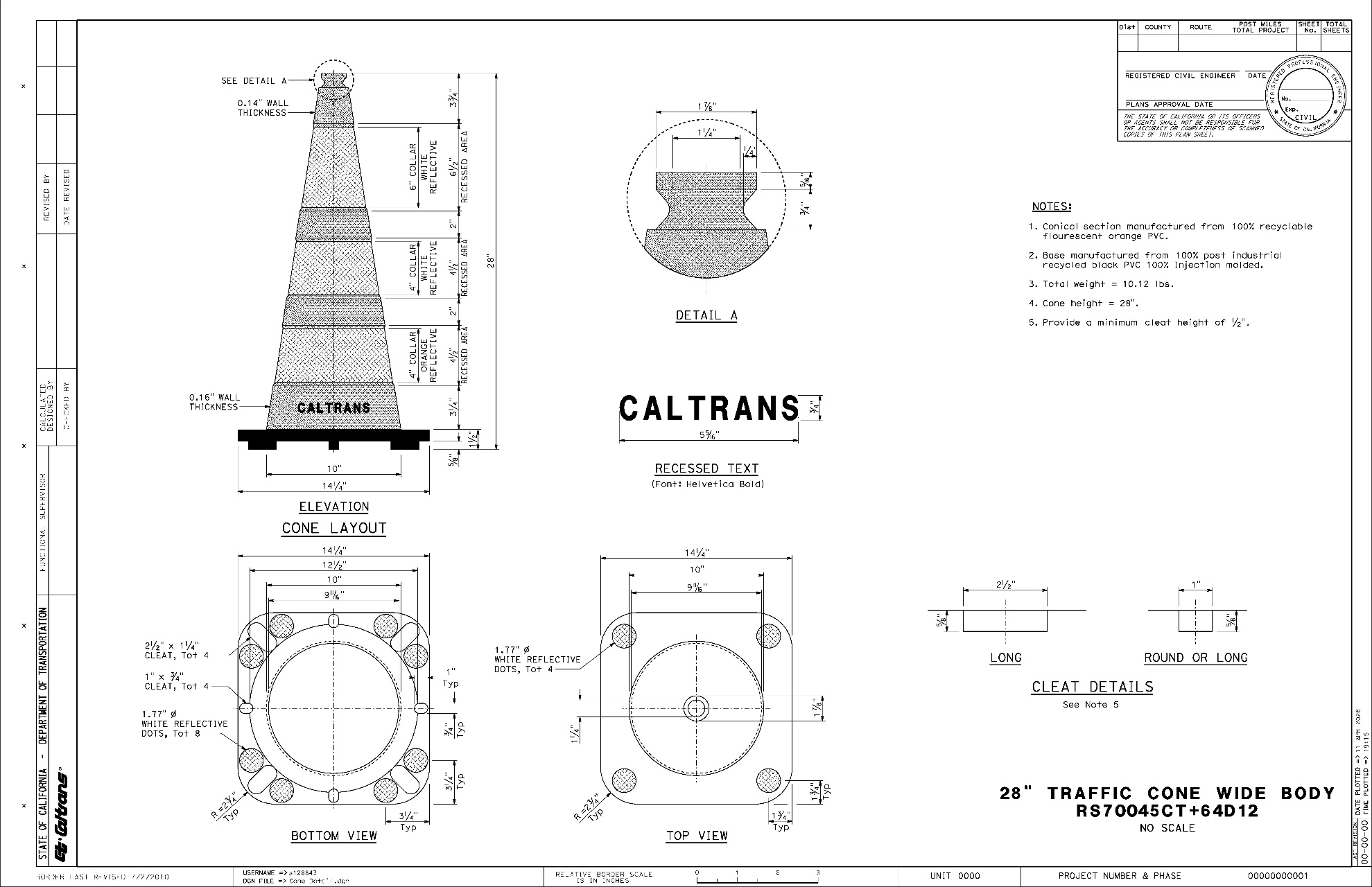
Figure 1. Fluorescent plastic traffic cones with sleeves
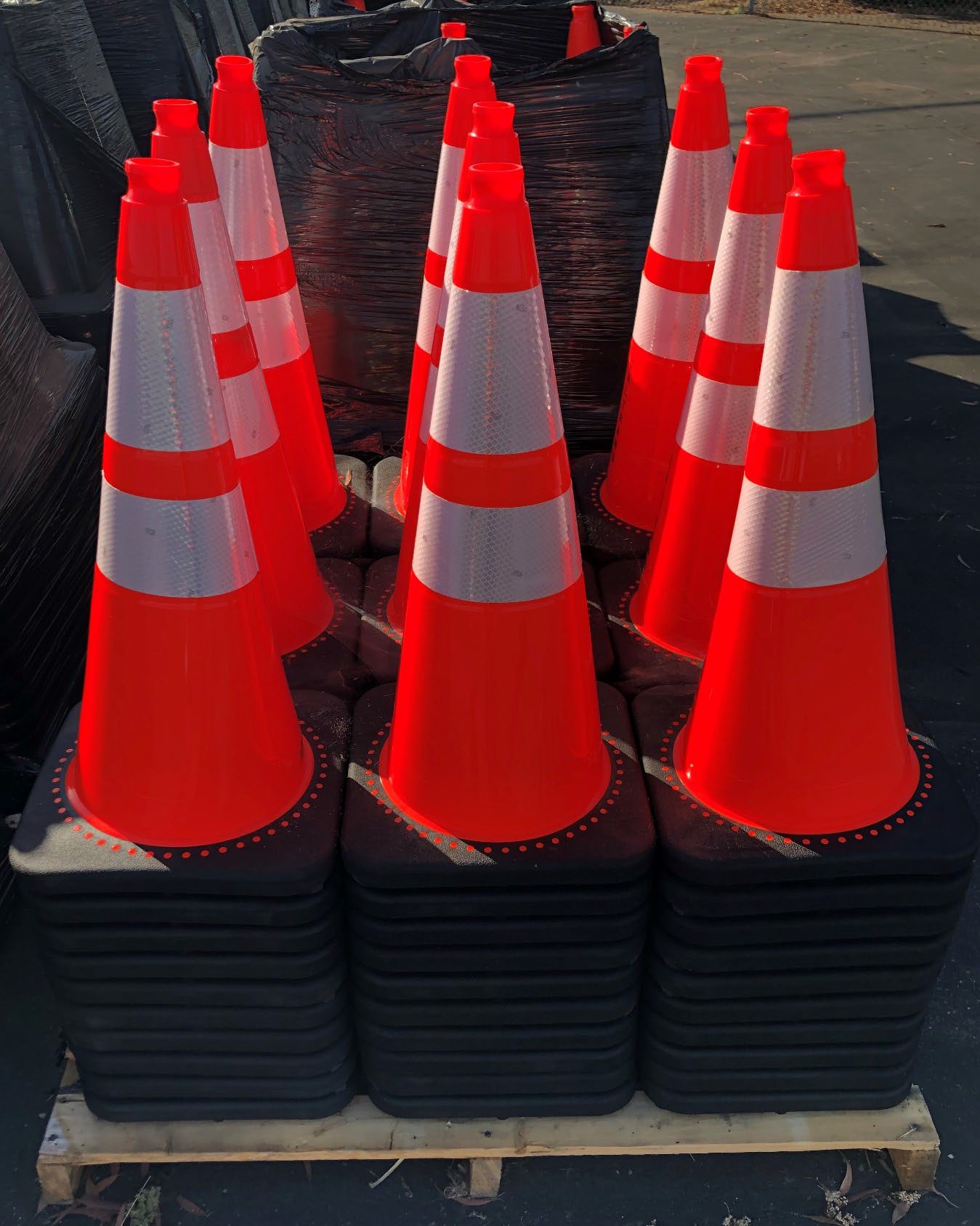
Figure 2. Stacks of traffic cones
Caltrans contact: FNU Novendra, Chemistry.Branch@dot.ca.gov